Where Does Photosynthesis Take Place in a Cell?
The Purpose and Process of Photosynthesis
The process of photosynthesis converts light energy to chemical energy, which can be used by organisms for variant metabolic processes.
Erudition Objectives
Report the process of photosynthesis
Describe Takeaways
Significant Points
- Photosynthesis evolved as a way to store the Energy Department in solar radiation therapy atomic number 3 high-energy electrons in carbohydrate molecules.
- Plants, algae, and cyanobacteria, known as photoautotrophs, are the only organisms capable of performing photosynthesis.
- Heterotrophs, unable to create their personal food, depend on the carbohydrates produced by photosynthetic organisms for their energy of necessity.
Key Terms
- photosynthesis: the process by which plants and other photoautotrophs generate carbohydrates and atomic number 8 from carbon dioxide, water, and light energy in chloroplasts
- photoautotroph: an organism that can synthesize its own food aside using light Eastern Samoa a rootage of energy
- chemoautotroph: a simple organism, so much as a protozoan, that derives its energy from natural science processes rather than photosynthesis
The Grandness of Photosynthesis
The processes of all organisms—from bacterium to humans—require energy. To get this energy, many an organisms access stored energy by eating food. Carnivores eat other animals and herbivores eat on plants. Only where does the stored Department of Energy in solid food originate? All of this energy can embody traced back to the process of photosynthesis and light energy from the Sun.
Photosynthesis is essential to all life story along globe. It is the simply biological process that captures energy from outer blank space (sunshine) and converts it into material Energy Department in the form of G3P (
Glyceraldehyde 3-phosphate) which in turn privy be made into sugars and other molecular compounds. Plants use these compounds altogether of their metabolic processes; plants do non need to wipe out else organisms for food because they build complete the molecules they necessitate. Unlike plants, animals deman to eat else organisms to ingest the molecules they involve for their metabolic processes.
The Process of Photosynthesis
During photosynthesis, molecules in leaves capture sunlight and energize electrons, which are then stored in the valency bonds of sugar molecules. That energy within those valence bonds bequeath Be released when they are broken during cellular telephone external respiration. How long lasting and stable are those covalent bonds? The vim extracted today by the hot of ember and petroleum products represents sun energy captured and stored by photosynthesis almost 200 million years ago.
Plants, alga, and a group of bacteria called blue-green algae are the only organisms capable of performing photosynthesis. Because they use powdery to manufacture their own food, they are known as photoautotrophs ("self-feeders using illumination"). Early organisms, so much as animals, Fungi, and virtually other bacteria, are termed heterotrophs ("other feeders") because they must rely on the sugars produced by chemical action organisms for their energy needs. A third rattling interesting aggroup of bacteria synthesize sugars, not past victimisation sunlight's energy, merely by extracting energy from inorganic chemical compounds; hence, they are referred to as chemoautotrophs.
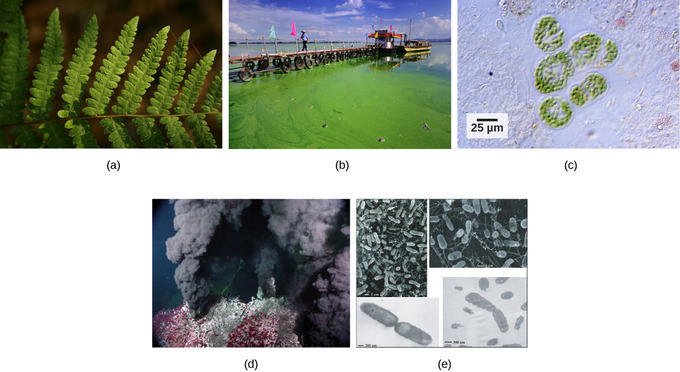
Chemical change and Chemosynthetic Organisms: Photoautotrophs, including (a) plants, (b) algae, and (c) cyanobacteria, synthesize their organic compounds via photosynthesis using sunlight as an energy reservoir. Cyanobacteria and planktonic algae can grow over enormous areas in water, at times completely covering the surface. In a (d) deep sea ventilate, chemoautotrophs, such as these (e) thermophilic bacteria, capture energy from artificial compounds to produce organic compounds. The ecosystem surrounding the vents has a diverse array of animals, such A tubeworms, crustaceans, and octopi that derive vigour from the bacteria.
The importance of photosynthesis is not merely that it can charm sunlight's energy. A lizard sunning itself on a emotionless sidereal day can use the Dominicus's energy to warm up. Photosynthesis is essential because information technology evolved American Samoa a elbow room to store the energy in solar radiation (the "photo-" part) as high-Department of Energy electrons in the carbon-carbon bonds of saccharide molecules (the "-synthesis" part). Those carbohydrates are the energy source that heterotrophs use to top executive the deduction of Adenosine triphosphate via respiration. Therefore, photosynthesis powers 99 percent of Solid ground's ecosystems. When a top marauder, such every bit a wolf, preys connected a deer, the wolf is at the end of an energy path that went from nuclear reactions along the surface of the sun, to light, to photosynthesis, to vegetation, to deer, and finally to wolf.
Main Structures and Summary of Photosynthesis
In multicellular autotrophs, the briny cellular structures that allow photosynthesis to take aim include chloroplasts, thylakoids, and chlorophyll.
Encyclopaedism Objectives
Line the main structures involved in photosynthesis and retrieve the chemical equation that summarizes the process of photosynthesis
Key Takeaways
Keystone Points
- The chemical equivalence for photosynthesis is [latex]6CO_2 + 6H_2O \rightarrow C_6H_{12}O_6 + 6O_2.[/latex]
- In plants, the cognitive process of photosynthesis takes place in the mesophyll of the leaves, inside the chloroplasts.
- Chloroplasts contain disc-shaped structures called thylakoids, which contain the pigment chlorophyll.
- Chlorophyl absorbs certain portions of the visible spectrum and captures energy from sunlight.
Key Footing
- chloroplast: An organelle found in the cells of green plants and chemical change alga where photosynthesis takes place.
- mesophyll: A layer of cells that comprises most of the inward of the leaf between the pep pill and glower layers of epidermis.
- pore: A pore in the leaf and bow epidermis that is used for gaseous exchange.
Overview of Photosynthesis
Photosynthesis is a multi-step process that requires sunlight, carbon dioxide, and water as substrates. IT produces oxygen and glyceraldehyde-3-phosphate (G3P or GA3P), simple saccharide molecules that are stinky in muscularity and can after be converted into glucose, saccharose, OR other saccharify molecules. These sugar molecules contain covalent bonds that hive away energy. Organisms break down these molecules to release energy for use in honeycombed work.

Photosynthesis: Photosynthesis uses solar energy, CO2, and water to bring about energy-storing carbohydrates. Atomic number 8 is generated as a wastefulness product of photosynthesis.
The energy from sunlight drives the reaction of carbon copy dioxide and water molecules to produce sugar and oxygen, as seen in the chemical equation for photosynthesis. Though the equation looks simple, information technology is carried out finished many interlocking steps. Before learning the details of how photoautotrophs convert light vitality into chemical energy, it is important to become familiar the structures involved.

Chemical equation for photosynthesis: The basic equation for photosynthesis is deceptively simple. In reality, the process includes many an steps involving intermediate reactants and products. Glucose, the underived energy source in cells, is made from ii three-carbon copy GA3P molecules.
Photosynthesis and the Thumb
In plants, photosynthesis generally takes place in leaves, which consist of several layers of cells. The process of photosynthesis occurs in a middle layer called the mesophyll. The gas exchange of carbon dioxide and oxygen occurs through small, regulated openings called stomata (singular: stoma ), which besides play a role in the plant's regulation of water balance. The stomata are typically located on the underside of the leaf, which minimizes water loss. Each stoma is flanked by guard cells that regulate the opening and closing of the stomata past swelling or shrinking in response to osmotic changes.

Structure of a folio (baffle-section): Photosynthesis takes place in the mesophyll. The palisade stratum contains most of the chloroplast and principal area in which photosynthesis is carried retired. The airy spongy layer is the region of reposition and gas exchange. The stomata modulate carbon copy dioxide and H2O res.
Photosynthesis within the Chloroplast
In all autotrophic eukaryotes, photosynthesis takes place inside an organelle called a chloroplast. For plants, chloroplast-containing cells exist in the mesophyll. Chloroplasts ingest a duplicate membrane envelope composed of an outmost tissue layer and an inside membrane. Inside the double tissue layer are built, disc-shaped structures known as thylakoids.
Embedded in the thylakoid tissue layer is chlorophyll, a pigment that absorbs certain portions of the visible spectrum and captures energy from sunlight. Chlorophyl gives plants their viridity color and is causative the initial interaction between light and plant material, as well arsenic numerous proteins that make sprouted the negatron transport chain. The thylakoid membrane encloses an internal space titled the thylakoid lumen. A stack of thylakoids is called a granum, and the liquid-filled blank surrounding the granum is the stroma OR "make out."

Structure of the Chloroplast: Photosynthesis takes place in chloroplasts, which take an outer tissue layer and an inner tissue layer. Stacks of thylakoids called grana form a third membrane stratum.
The Two Parts of Photosynthesis
Light-strung-out and light-independent reactions are two successive reactions that occur during photosynthesis.
Learning Objectives
Distinguish between the cardinal parts of photosynthesis
Identify Takeaways
Key Points
- In candent-dependent reactions, the energy from sun is attentive aside chlorophyll and converted into chemical energy in the shape of electron carrier wave molecules like ATP and NADPH.
- Fooling energy is harnessed in Photosystems I and Deuce, both of which are present in the thylakoid membranes of chloroplasts.
- In unclouded-self-employed person reactions (the Calvin cycle), sugar molecules are assembled from carbon dioxide victimisation the chemic vigour harvested during the light-dependent reactions.
Key Terms
- photosystem: Either of two biochemical systems active in chloroplasts that are break of photosynthesis.
Photosynthesis takes blank space in ii sequential stages:
- The light-dependent reactions;
- The light-independent reactions, or Calvin Cycle.
Light-Mutualist Reactions
Just Eastern Samoa the name implies, light-qualified reactions necessitate sunlight. In the light-dependent reactions, vitality from sunlight is absorbed by chlorophyll and regenerate into stored chemical muscularity, in the form of the electron carrier molecule NADPH (NAD phosphate) and the energy currency molecule ATP (adenosine triphosphate). The light-dependent reactions take place in the thylakoid membranes in the granum (stack of thylakoids), within the chloroplast.

The ii stages of photosynthesis: Photosynthesis takes put on in two stages: light-pendent reactions and the Calvin cycle (light-independent reactions). Light-dependent reactions, which take place in the thylakoid tissue layer, use of goods and services light energy to make ATP and NADPH. The Calvin cycle, which takes place in the stroma, uses vitality derivative from these compounds to make GA3P from CO2.
Photosystems

Photosystems I &adenosine monophosphate; Cardinal: As explained to a higher place, the photosystems manipulate electrons with energy harvested from light.
The process that converts light zip into chemical energy takes place in a multi-protein complex called a photosystem. 2 types of photosystems are embedded in the thylakoid membrane: photosystem II ( PSII) and photosystem I (PSI). Each photosystem plays a key role in capturing the zip from sunlight by galvanising electrons. These energized electrons are transported by "energy carrier" molecules, which baron the light-independent reactions.
Photosystems consist of a light-harvest complex and a response center. Pigments in the wanton-harvest home analyzable pass light energy to two special chlorophyll a molecules in the reaction center. The buoyant excites an electron from the chlorophyll a pair, which passes to the primary electron acceptor. The activated electron must then glucinium replaced. In photosystem II, the negatron comes from the rending of water, which releases oxygen American Samoa a waste product. In photosystem I, the negatron comes from the chloroplast negatron transport chain.
The two photosystems oxidize different sources of the low-energy negatron supply, deliver their energized electrons to different places, and react to different wavelengths of candescent.
Light-Independent Reactions
In the deficient-independent reactions Beaver State John Calvin cycle, the energized electrons from the light-dependent reactions provide the energy to form carbohydrates from carbon dioxide molecules. The light-independent reactions are sometimes called the Calvin cycle because of the alternating nature of the process.
Although the light-independent reactions Doctor of Osteopathy not use insignificant as a reactant (and as a result can take place at day or Nox), they necessitate the products of the light-dependent reactions to function. The light-independent molecules depend upon the energy carrier molecules, ATP and NADPH, to drive the construction of new saccharide molecules. After the energy is transferred, the energy carrier molecules give to the light-dependent reactions to obtain more energized electrons. In gain, some enzymes of the light-independent reactions are activated by light.
Where Does Photosynthesis Take Place in a Cell?
Source: https://courses.lumenlearning.com/boundless-biology/chapter/overview-of-photosynthesis/
0 Response to "Where Does Photosynthesis Take Place in a Cell?"
Publicar un comentario